


Microneedling And PRP For Scars And Rejuvenation
Microneedling is a minimally invasive skin rejuvenation procedure in which multiple tiny micro-injuries are created in the skin using a specialized device such as a dermaroller or dermapen. These controlled micro-holes stimulate the body's natural healing response, leading to the release of growth factors and activation of collagen and elastin production. As new collagen forms, the skin becomes firmer, smoother, and healthier in appearance.
This collagen induction process is especially effective for treating atrophic acne scars, where the skin has lost volume and structure. By encouraging the formation of new collagen tissue, microneedling gradually improves skin texture and reduces the depth of scars.
Since microneedling promotes the generation of new, healthy skin cells to replace damaged or aged ones, its applications are wide-ranging. It is commonly used to treat fine lines and wrinkles, skin laxity, stretch marks, pigmentation issues, enlarged pores, and sun-damaged skin. It is also used in hair restoration treatments to stimulate hair follicles and improve hair growth. Safe for most skin types, microneedling offers noticeable improvement with minimal downtime when performed by trained professionals.
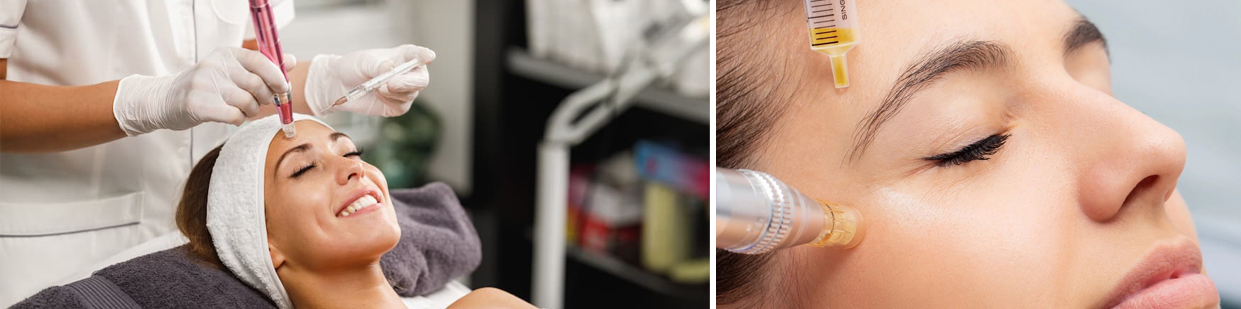
How It Works
Microneedling creates controlled micro-injuries in the skin using a dermapen or dermaroller. These tiny channels stimulate the body's natural healing response and boost collagen and elastin production.
PRP, prepared from your own blood, is rich in growth factors. When applied during or after microneedling, PRP penetrates deep into the skin through the microchannels, enhancing tissue repair and collagen formation.
Dermapen vs Dermaroller
Dermaroller is old device which consists of a rolling pin covered with tiny needles. During a derma roller treatment, the roller is rolled across the skin, leaving behind a trail of microscopic punctures.
Dermapen is a new automated oscillating device. It has several advantages over dermaroller, in dermapen treatment needles enter the skin at a 90 degree angle, eliminating the pain and epidermal tearing associated with dermal rollers. It has smaller surface area which comes in contact with the skin, which allows it to treat those hard to reach areas quickly, easily, and effectively, which are difficult to treat in dermaroller. Also with dermapen depth can be adjusted for different areas of face. Overall results are better and more consistent with dermapen.
PRP with microneedling
Platelet rich plasma is rich in growth factors. When PRP is used along with microneedling its penetration is increased into skin through these microchannels. Growth factors present in PRP stimulate better healing of microholes made during microneedling and leads to better scar treatment and facial rejuvenation.
Procedure
A topical anaesthetic cream is applied over face for 45 minutes. After that cream is removed and microneedling is done. There is minimal to no pain. It takes only 10 to 15 min for microneedling. After procedure there is mild erythema and swelling which usually subside in few hours. Usually multiple sessions are needed at 1monthly intervals.
Benefits of Microneedling with PRP
- Improves acne and atrophic scars
- Reduces fine lines and wrinkles
- Tightens and firms skin
- Improves skin tone and texture
- Reduces pigmentation
- Enhances overall skin glow
- Minimal downtime
Results & Sessions
- Mild redness for 1–2 days
- Visible improvement in 3–4 weeks
- Best results after 3–4 sessions
- Sessions spaced 4–6 weeks apart
Frequently Asked Questions
- Acne scars
- Surgical scars
- Stretch marks
- Fine lines & wrinkles
- Enlarged pores
- Uneven skin texture
- Dull or aging skin